
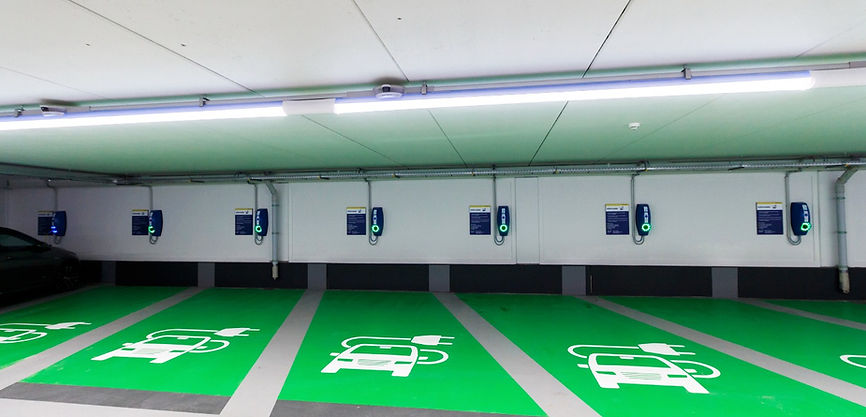
Business EV Charging
When choosing EV chargers for your business there are a few things to consider. Power limits of the site, who is using the chargers, pay-per-use or free, staff, fleet or customer use? Also, do you choose AC charging or do you need the fast turnaround of DC?
We can help you work through these decisions to find the best solution for your business that will set you up for an electric future.

Fleet Charging
Will your EVs be charged at work or by employees if they take them home? Or is it both? Either way, you can track usage and control access to chargers with backend software to give you full control.
Staff Charging
EV charging for staff can be both either free or pay-to-use. This is up to your business and how you want to handle the costs. You can utilise backend software to monitor access and monetise if you choose.


Customer Charging
Providing EV charging for your customers can offer you a point of difference and entice them to spend more time at your business. It is up to you whether you monetise this or not.
Developers
Future-proof your developments for EV charging. Pre-wire your site for chargers or install the EVBox Elvi Wall Dock. Wall Dock allows users to click on the main charger unit when they get an EV and be ready to charge.

Some of our recommended business chargers
.jpg)
EO Genius
7.2/11/22kw
Pair with EO Hub to control up to 30 chargers

EVBox Elvi
7.4/11/22kw
Home or fleet. Connect up to 20 chargers with hub/satellite.

EVBox BusinessLine
7.4/11/22kw
Single or Double. Connect up to 20 chargers with hub/satellite

Efacec QC45
50kw DC
Charge 0-80% in under 30 minutes
AC or DC Charging?
AC charging at the workplace is ideal because:
-
Cars tend to be parked for many hours enabling a full charge
-
AC chargers are relatively cheap and you can add to your charging fleet easily over time
-
Smart chargers can manage load and allocate energy to the car efficiently
-
One smart AC charger with communications can manage up to 20 less advanced chargers, reducing costs


These are the key considerations for workplace charging:
-
Cables: we recommended socketed chargers (no cable attached) to allow every EV on the market to charge now and into the future. Chargers with attached cables limit you to one type of vehicle.
-
Communications: we recommend smart chargers with communications capability (modem/ethernet/WIFI) and OCPP. These chargers can be remotely supported and managed and have a wide range of features basic chargers don't.
-
Monetisation: we recommend chargers with the ability to be monetised, even if you don't turn this on today. When 2% of staff vehicles are EVs it's a novelty when 50% are EVs it can become a large cost.
If you are needing a fast-charging turnaround you may consider a DC charger.
Some considerations for DC:
-
DC chargers are relatively expensive compared to AC chargers
-
DC chargers are for fast turnaround taking 30-40 minutes to charge to 80% from near empty. Most staff won't drive that far to work so an AC top-up could be sufficient.
-
Charging etiquette will need to be established to avoid conflict between staff needing a quick charge
